
How to make kombucha at home: the complete guide
Kombucha is a tangy, slightly fizzy drink made from fermented tea. You can brew it at home with just a handful of ingredients, and once you have a starter you can keep making it for the rest of your life. In this article you will learn the process step by step: with a SCOBY, without one, and how to create your own flavour combinations.

What is kombucha?
Kombucha is a fermented tea drink, probably originating somewhere in East Asia. The exact origins are unknown. You make it by fermenting sweet tea with a combination of bacteria and yeasts. That partnership is called a SCOBY: Symbiotic Culture of Bacteria and Yeast. The lactic acid bacteria, acetic acid bacteria and yeasts convert the sugar into acids, a small amount of alcohol and carbon dioxide. The result is a drink that tastes pleasantly tart, has a light fizz, and lends itself to endless variation.
During fermentation, a jelly-like disc of cellulose forms on the surface. Almost everyone calls this disc “the SCOBY”, but technically it is called the pellicle or biofilm. It is also affectionately known as “the mother”. The real SCOBY is the whole thing: the liquid and the pellicle together. When we refer to “SCOBY” in this article, we mean exactly that: the liquid plus the pellicle, together forming the living starter you need.
Making kombucha: what do you need?
You do not need much to make kombucha.
Materials:
- A glass jar (at least 1 litre, thoroughly cleaned with hot water)
- A thin cloth and rubber band to cover the jar
- Pressure-resistant bottles (swing-top or PET bottles) for the second fermentation
- A sieve and funnel
Ingredients:
- 1 litre of water
- Black tea, approx. 5-7 grams per litre (plain, no Earl Grey or fruit tea)
- Sugar, 50-100 grams per litre (regular granulated or cane sugar)
- About 100 ml of mature kombucha plus a pellicle as starter
That starter is the only ingredient you will not find at the supermarket. Want everything in one box? Our kombucha starter kit contains everything you need. You can also order a SCOBY on its own.

Making kombucha with a SCOBY
This is the standard method and by far the most reliable way to get started.
- Boil water and brew tea (5-7 grams per litre). Dissolve 50-100 grams of sugar per litre in the hot tea.
- Let the sweet tea cool completely to room temperature. Tea that is too hot will kill the microorganisms in your starter. Make sure your glass jar is clean. Rinse it thoroughly with hot water beforehand.
- Pour the cooled tea into the jar. Add roughly 10% mature kombucha (so 100 ml per litre) along with the pellicle.
- Cover the jar with a cloth and secure it with a rubber band. Do not use a lid: the fermentation needs oxygen.
- Place the jar somewhere at room temperature or slightly warmer (20-30°C), out of direct sunlight. Higher temperatures speed up fermentation and produce a more sour result.
- Let it ferment for 7 to 14 days. After a week, taste regularly with a clean spoon. Pleasantly tart and no longer too sweet? Then it is ready.
Optional: measure the pH. It should be below 4.6. Ideal for kombucha is 2.5 to 3.5. - Always save at least 10% of your kombucha along with the pellicle for your next brew.
Want to know more about safe brewing, recognising mould and common problems? Read Is kombucha safe to drink?
You can order a tested, organic kombucha SCOBY from us, guaranteed free of pathogens.
Making kombucha without a SCOBY
No SCOBY at hand? You can also start with a bottle of unpasteurised kombucha from the shop. Use the bottle as your starter instead of the 10% mature kombucha: add it to cooled sweet tea and let it ferment. After a few weeks, a new pellicle will form on the surface by itself.
It works, but there are downsides. Fermentation takes longer to get going, the result is less predictable, and you do not know exactly which microorganisms are in that bottle. On top of that, most kombucha in the supermarket is pasteurised. Always check the label, because pasteurised kombucha no longer contains live cultures and will not work as a starter. With a tested SCOBY you get started faster, more safely and with more consistent results.
Second fermentation (F2): flavour and fizz
Once your base kombucha is ready, you can do a second fermentation. This is also called F2. During F2, you add flavourings and create carbonation. Ginger kombucha is the most popular variation, but the possibilities are wide open.
Example: ginger kombucha
- Pour your finished kombucha (without the pellicle) into a pressure-resistant bottle.
- Add a few slices of fresh ginger, and optionally a slice of lemon.
- Optionally add a teaspoon of sugar.
- Seal the bottle tightly.
- Leave for 1-7 days at room temperature. The yeasts convert the remaining sugar into carbon dioxide.
- Then put the bottle in the fridge to stabilise the pressure. Open carefully, preferably over the sink.
Note: the more fruit or pulp you add, the more pressure can build up in the bottle. Be careful with that. Other popular combinations: blueberry-ginger, cranberry-orange, fig with rosemary, or strawberry-pineapple. Looking for more ideas? Read 5 surprising things you can do with kombucha.
Making and maintaining your kombucha starter
Once you have started, you never have to begin from scratch again. After each brew, save at least 10% of the liquid along with the pellicle. That is your starter for the next round.
Scaling up is straightforward. From 100 ml of starter you make 1 litre. From 1 litre you make 10 litres. And so on. Always use at least 10% starter relative to the total volume.
Taking a break from brewing? Store your SCOBY in a sealed jar with some kombucha in the fridge. Research by Leandra Brandwijk (Leiden University of Applied Sciences, 2022) shows that the fridge is the best place to store your SCOBY for longer periods: the microbial community stays stable and the SCOBY recovers well when you start again. The freezer does not work well. The frozen bacteria barely recover.

Frequently asked questions

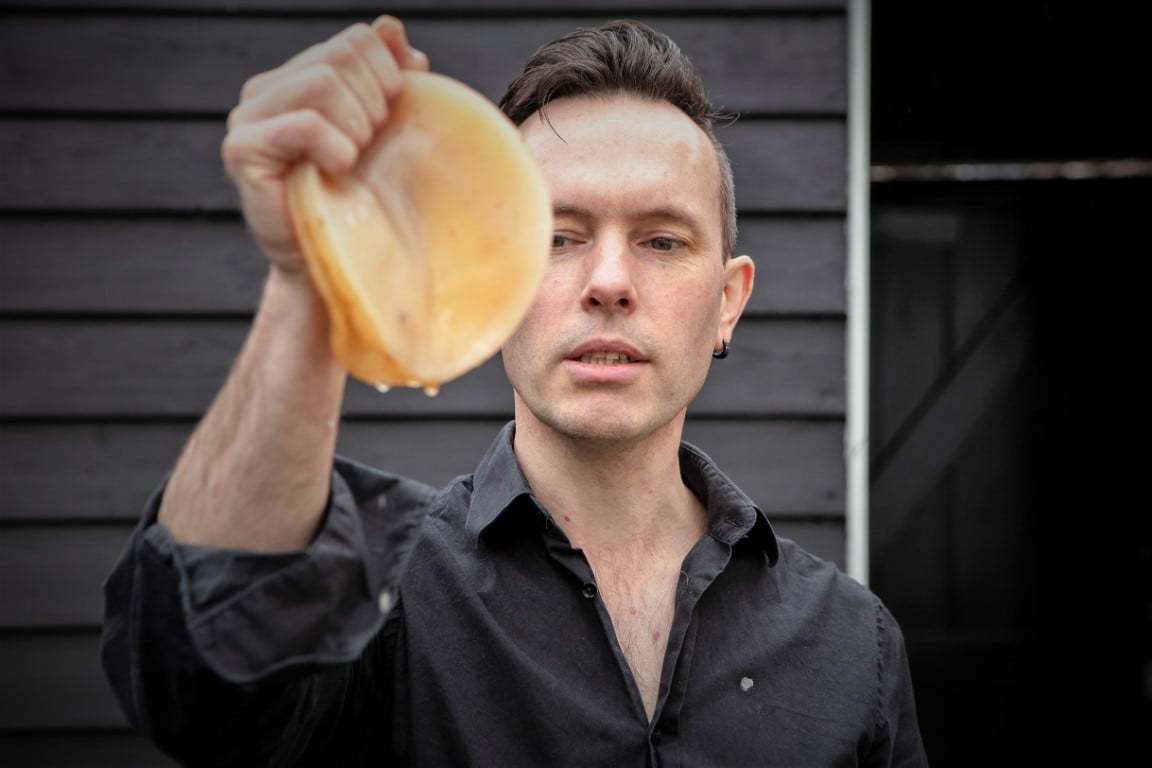
About the author (Meneer Wateetons)
Meneer Wateetons is a renowned Dutch foodwriter, teacher, fermentation specialist, sausage maker and the owner of startercultures.eu. He has written 9 books on culinary topics such as fermentation, alcohol making, sausages and charcuterie making and deep frying. He has taught many hobbyists, chefs and food professionals about these topics.
2 Comments
Leave A Comment
Related Posts

How to make sauerkraut – including a recipe
How to make sauerkraut: recipe and everything about fermentation Category: Fermentation Making sauerkraut is one of the easiest things you can do [...]
Fermented food: is it healthy? The honest story
Is fermented food healthy? We look at what science actually says: what is proven, what is likely, and what is still uncertain. Plus tips for getting started yourself.
Which coagulant should you use to make tofu at home? The three main options compared
Which tofu coagulant is best? We compare calcium sulfate, nigari and GDL: dosages, texture, flavour and when to use each one.
est