
Tempeh making kit | all-in-one starter kit, free course included


Tempeh is a fermented soybean cake from Indonesia, nutty in flavour with a firm bite. Get started with making your own tempeh using this starterkit with a cool discount! And with free online course!
Product Description
What is tempeh?
Tempeh is a fermented soybean cake from Indonesia, nutty in flavour with a firm bite. You make it from soy beans, but it also works well with other beans. In many cases the result is even tastier. Our tempeh starter is the original Indonesian variety with both Rhizopus Oligosporis and Rhizopus Oryzae fungi. Get started with making your own tempeh using this starterkit with a cool discount! And with free online course!
Content of the ‘make your own tempeh’ starter kit
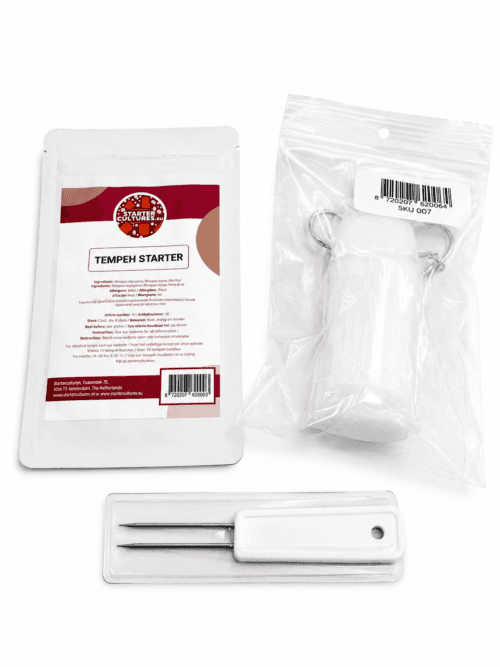
- 25 grams of tempeh starter culture (enough for 15 kg!)
- 5 set of 50 mm plastic casings (perfect shape for your tempeh)
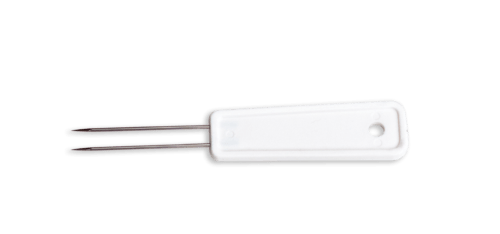
- 1 pricker (for punctering air holes in your casing)
- And with free online course!
Tip: a precision scale that measures in increments of 0.01 gram is not included, but is useful because you measure out the culture in tenths of a gram.
How to make your own tempeh using our ‘make your own tempeh’ starter kit
Ingredients:
- 4 1/2 cups hulled soy beans (if using beans with the hulls intact, see below for extra steps)
- 2 tbsp. Vinegar
- 2 ½ tsp. tempeh starter culture
Steps to make your own tempeh:
- Soak the beans: place the beans in a large bowl of water with an extra 3 inches on top. Leave it over night or for at least 12 hours.
- Boil the soybeans for one hour or more to cook. If using a pressure cooker for about 45 min.
- Dehull the beans by slowly rubbing the beans together in plenty water. The hulls will start to flow on top. Scoop them off.
- Discard the cooking water and dry the beans (either using a towel to pat them dry or setting over low heat in the pot to evaporate the water off the beans). It is important for the beans to be dry to the touch, as too much moisture can ruin the batch.
- Place the beans in a dry bowl and allow the beans to cool to skin temperature (appr. 37˚ C)
- Add the vinegar and mix well. The vinegar provides protection against spoilage. Let dry some more.
- Add the tempeh starter and mix well to evenly distribute the starter in the beans.
- Place the beans in the provived casings, using a spoon. Make sure they are very thightly pressed together.
- Puncture holes all around the casing with the pricker.
- Close the casing, making sure it’s tight.
- Incubate the beans at 25-35°C for 24-48 hours.
- Check the beans after 12 hours. At this point in the process the fermentation will cause the beans to generate their own heat so you will normally need to reduce or even eliminate the external heat source. Be sure to use a thermometer to check the actual temperature (see below).
- After 24 hours or so, the white mycelium will start to cover the surface of the beans. Over the next few hours the white mycelium will grow through the beans and will smell nutty.
Making tempeh safely
- Acidify the cooked beans with vinegar before you add the starter. Acidify the beans themselves, not the soaking water. Unacidified beans at 30 degrees are an excellent growth medium for bacteria you do not want.
- Treat fresh tempeh as a raw product. Keep it refrigerated, keep it away from food you will not heat again, and fry, deep-fry or steam it through before you eat it.
- Start every batch with fresh starter. We advise against back-slopping with a piece of the previous batch.
- Discard anything that smells off, feels slimy or is unusually discoloured.
Online tempeh making course 
Read More >
11 reviews for Tempeh making kit | all-in-one starter kit, free course included
Tempeh is a fermented soybean cake from Indonesia, nutty in flavour with a firm bite. Get started with making your own tempeh using this starterkit with a cool discount! And with free online course!


![Online tempeh making course [C]](https://startercultures.eu/wp-content/uploads/2026/06/Fermentation-Fundamental-logo-small--500x542.png)


Easy to use, sharp pricker, sturdy casing.
Nog niet gebruikt? Ik heb de producten nog niet gebruikt dus ik weet het nog niet,
Actually, the “casings” are not necessary in the starter kit.
Nog niet gebruikt? Ik heb de producten nog niet gebruikt dus ik weet het nog niet,