
On-site fermentation workshops for chefs, culinary schools and businesses
Over the past fifteen years, fermentation has gone from hype to standard practice in kitchens. From Michelin-starred restaurants to the neighbourhood bistro, there is something fermented on the menu every day: a garum, a koji marinade, a house hot sauce. If you serve it, you need to know what is going on in those jars, and why it works one time but not the next.
Meneer Wateetons comes to you for exactly that. He runs on-site fermentation workshops and training for kitchen brigades, culinary schools, teachers and food businesses, in the Netherlands and well beyond, with courses lasting from half a day to three days. He teaches in English or Dutch.

25+
online fermentation courses
9
cookbooks
6
countries taught in


½ to 3
days per training
Understanding the process
You can find a recipe anywhere. After this training, your team goes home understanding the process. Which bacteria, yeasts and moulds do the work, what do they need, and how do you steer them in the right direction? Once you understand that, you can apply a technique to an ingredient that appears in no recipe book at all, and get the same quality every time.
We work in percentages, not tablespoons.

Safe fermentation in a professional kitchen
Serving fermented food means working with live microorganisms. That takes more than a good recipe: you need to be able to show that it is safe. That is why food safety is covered in every training session, always within the framework of your HACCP plan.
That way, you can serve fermented food with confidence and know what to show the food safety inspector.
Who it is for

How it works
Every training session starts with the fundamentals: what fermentation is, which microorganisms are involved, why it works and how to work safely. Vegetable fermentation is always included, because it is the best stepping stone to everything else. After that, you choose the topics.
In a half-day session we cover two to three topics through hands-on work. Would you prefer more theory and tasting, with less hands-on work? Then we can cover three to four topics. You can also choose a focus: plant-based fermentation, zero waste and the use of by-products, local produce, or your restaurant’s own signature style.
The training takes place in your own kitchen or classroom, for groups of eight or more. Meneer has taught in the Netherlands, Belgium, France, Austria, Sweden and Curaçao, so travel is not a problem.
Every participant receives a handout, a certificate of attendance and free access to an online course of their choice. We put the programme together with you.
Topics
If your topic is not on the list, just ask. Chances are Meneer has written a chapter about it.

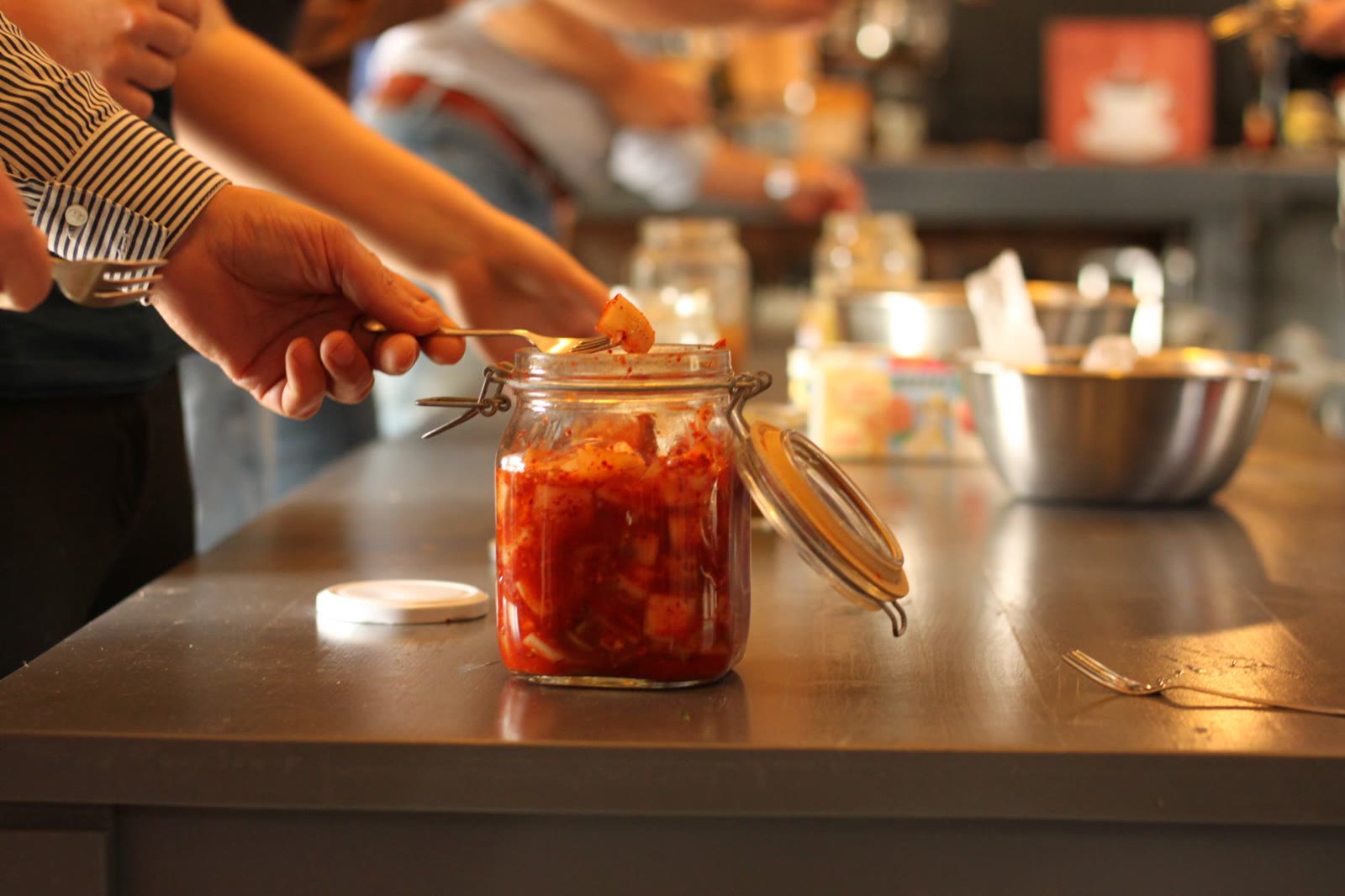

A look inside the kitchen
This is what a fermentation course in Curaçao looked like.
Your teacher
Meneer Wateetons is a scientist with a PhD, a cook, and the author of nine Dutch cookbooks on fermentation, preserving, sausage making and smoking. His fermentation handbook Over Rot was nominated for Dutch Cookbook of the Year and for the Gourmand World Cookbook Awards. The Dutch trade magazine Bouillon judged his books “good enough to be used as standard textbooks in professional culinary schools”. The Dutch newspaper de Volkskrant called him a “master of culinary experimentation”.
He has also created more than 25 online fermentation courses, which together make up the largest collection of online fermentation courses available in Dutch. More than 15 of them are also available here on Startercultures.eu, either taught in English or subtitled in English. His English is excellent, so a training session in English runs just as smoothly as one in Dutch, his native language.
He is also the founder of Startercultures.eu. So he knows not only how fermentation works, but also which culture you need and when. And why it sometimes does something quite different from what you had hoped.
Meneer has taught at every level, from pre-vocational students to postgraduates, and he is known for something rare in professional training: explaining complex material with absolute clarity and with humour. Your team learns a great deal and has a good laugh along the way.

Previous clients include











Culinary schools: ROC van Amsterdam (including its masterclass programme), De Rooi Pannen, Albeda College, ROC West-Brabant, Rijn IJssel, Koning Willem I College, NHL Stenden, Amsterdam University of Applied Sciences, Hotelschool The Hague, Gastronomixs and Horeca Forma in Brussels.
Restaurants: RIJKS, Breeze, Wannee, Hemel & Aarde, Ron Gastrobar, the chefs from the Gastronomisch Gilde, and a number of chefs in Curaçao, together with chef Helmi Smeulders.
Companies: Unilever, Bidfood, Marel, Janssen, UWV and Terra Sana.

For home cooks: the three-day fermentation course
Not a professional? Or would you rather attend an open course with a few colleagues? There is also the three-day fermentation course: three separate days covering every form of fermentation, from vegetables and dairy to koji, cheese and dry-cured sausage. Most participants are home cooks. Please note that this course is taught in Dutch. You can sign up at wateetons.com.
