
Vegetable fermentation kit | all-in-one starter kit, free course included
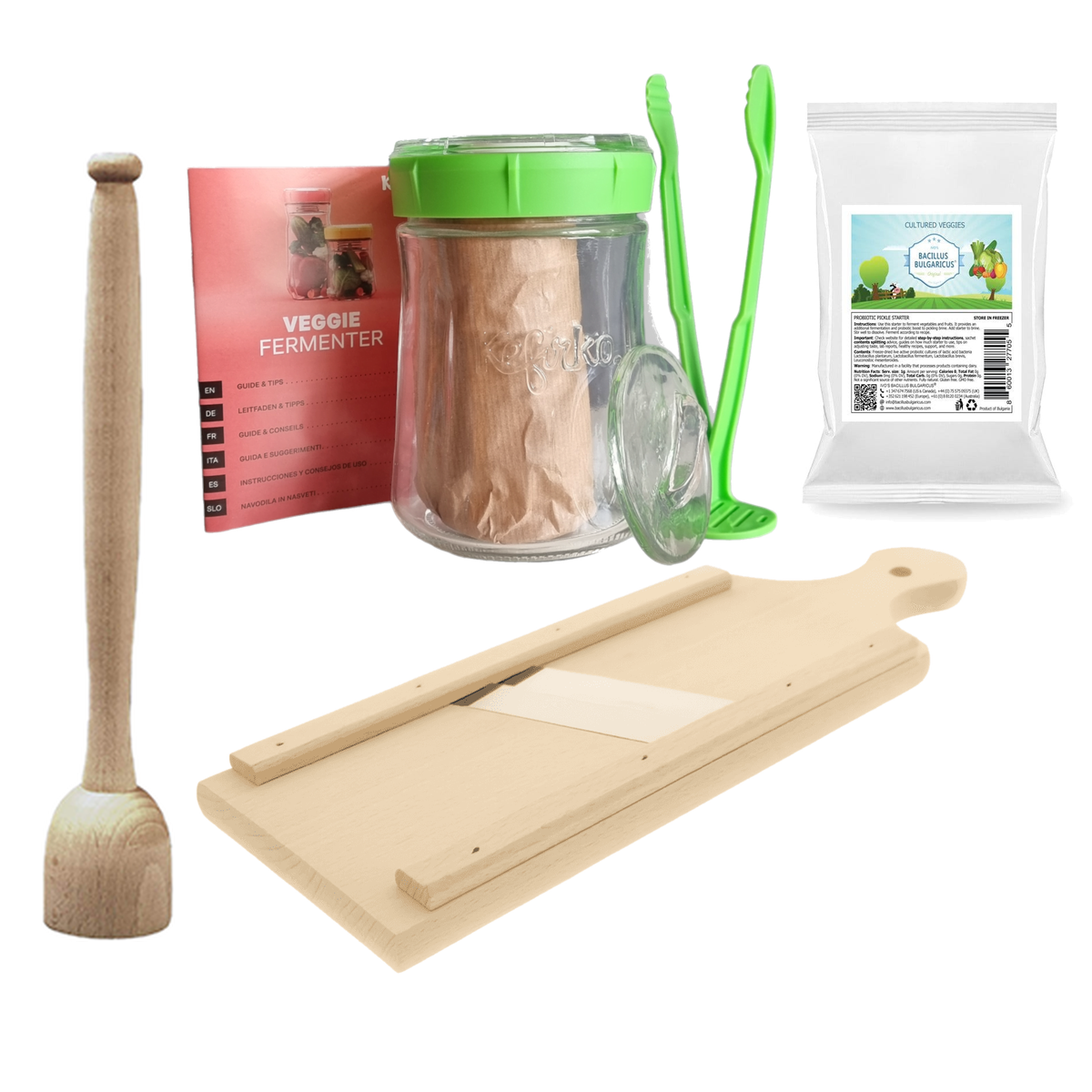

Everything you need to make sauerkraut at home: a Kefirko fermentation jar, a wooden vegetable slicer, a Pickle Pounder and a starter culture. A free online course is included, so you can ferment other vegetables too. You add the cabbage and the salt.
Product Description
Cabbage, salt and a week or two of patience give you sauerkraut. This kit contains the tools and the starter culture you need, plus a free online course that teaches you to ferment any other vegetable. All you need to buy separately is the cabbage and the salt.
How cabbage turns into sauerkraut
Salt draws water out of the cabbage, and pounding speeds that up. The cabbage ends up submerged in its own liquid, where the air cannot reach it. Lactic acid bacteria grow well there. They turn the sugars in the cabbage into lactic acid and carbon dioxide, and the acid preserves the vegetables and gives them their sour taste.
Those bacteria already live on the leaves, so a starter culture is not strictly necessary: cabbage will ferment without one. With the starter, four selected strains are present from day one. The fermentation starts sooner and is easier to control, and the result is more consistent and predictable from one batch to the next.
What the jar does
A glass weight and a spring keep the vegetables under the liquid. The silicone valve in the lid lets gas out and keeps air out, a carbon filter neutralises the smell, and the pump removes the air above the vegetables. The fermentation clock on the lid shows the day you started.
Contents of this vegetable fermentation kit
- Kefirko vegetable fermentation jar: 900 ml glass jar, lid with odour filter, pump, fermentation clock, spring, glass weight, tongs with a small pounder, and a recipe booklet
- Wooden vegetable slicer (mandoline), which cuts the cabbage very finely so the liquid comes out more easily
- Pickle Pounder, a wooden pounder for working salt into the cabbage in a bowl
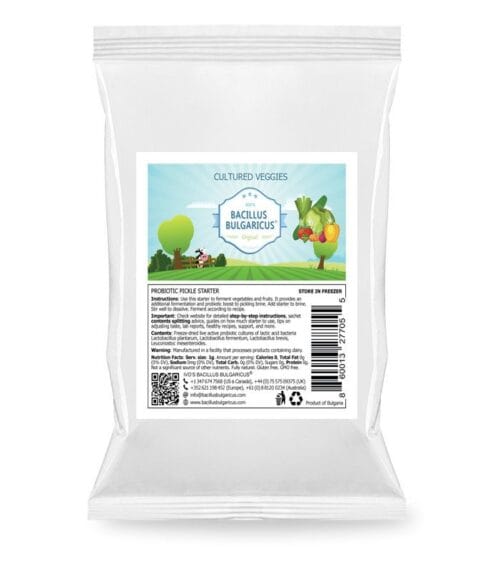
- Vegetable pickle starter, 2 g, enough for around 50 kg of vegetables. Made in Bulgaria.
- Online Vegetable Fermentation course, free with this kit
What else you need
- Cabbage or other vegetables
- Salt: 20 g per kg of vegetables
- A mixing bowl
- A kitchen scale
Allergens: milk
The starter culture contains a tiny amount of skimmed milk powder, so this kit is not vegan or lactose free.
Ingredients of the starter
Lactic acid bacteria (Lactobacillus plantarum, Lactobacillus fermentum, Lactobacillus brevis, Leuconostoc mesenteroides), skimmed milk powder.
Storage
Keep the starter in the freezer. It keeps for about 2 years; the use-by date is on the label.
How to make sauerkraut in this jar
- Remove the outer leaves and the tough core from the cabbage. You need about 700-900 g for one jar.
- Slice the cabbage as finely as you can using the slicer and place it in a mixing bowl.
- Add 20 g of salt per kg of cabbage (2%), so 14-18 g for one jar. Pound the cabbage vigorously with the Pickle Pounder for several minutes, or knead it firmly with your hands. Keep going until the cabbage has released as much liquid as possible, because that liquid has to cover the cabbage in the jar.
- Dissolve as much starter as fits on the tip of a knife in a tablespoon of water and stir it through the cabbage. You don’t need to weigh it: a little too much does no harm. Put the rest of the starter back in the freezer.
- Pack the cabbage and its liquid into the jar a little at a time, pressing it down as you go. Leave about 2.5 cm of space at the top. The liquid must cover the cabbage. If there is not enough liquid, top up with brine made with 20 g of salt per litre of water.
- Put the glass weight and the spring on the cabbage, close the lid, set the fermentation clock and pump out the air.
- Let the cabbage ferment for 1-2 weeks at room temperature, away from direct sunlight, or for 6-8 weeks at 5-10 °C.
- Open the jar and use a clean fork to taste the cabbage. Once you like the taste, it is ready.
Tips for fermenting vegetables
- For whole or chunky vegetables that release little liquid, such as carrots, cucumbers and cauliflower, use a brine. Cover the vegetables with water, weigh everything together, and add 2% salt and the dissolved starter. The method is on the Vegetable pickle starter page.
- One sachet is enough for many jars, so keep what you don’t use in the freezer.
Online Vegetable Fermentation course
In 25 short video lessons in English, Meneer Wateetons, founder of startercultures.eu and author of the fermentation handbook Over Rot, shows you how to ferment vegetables at home, safely and creatively. You will learn to ferment any vegetable and waste less food. This online course is free with this kit.
Read More >
Everything you need to make sauerkraut at home: a Kefirko fermentation jar, a wooden vegetable slicer, a Pickle Pounder and a starter culture. A free online course is included, so you can ferment other vegetables too. You add the cabbage and the salt.





1 review for Vegetable fermentation kit | all-in-one starter kit, free course included
Show only reviews in English (0)