
How to make kimchi: recipe, tips and variations
Category: Fermentation, Vegetables
Kimchi is spicy, sour, loaded with umami and thoroughly addictive. In Korea people eat it with every meal. Breakfast, lunch, dinner. Kimchi alone gets them more vegetables than most of us manage in an entire day.
Making kimchi at home is far easier than it looks. If you have ever made sauerkraut, you already have most of the skill you need. Same technique, different seasonings. This article covers the recipe, the traditional Korean method, versions without fish sauce and the many kinds of kimchi that exist.

Kimchi recipe
Most kimchi recipes you find online use the traditional brining method: pile coarse salt onto the cabbage, leave it overnight, rinse it off and hope the salt level lands somewhere sensible. That works beautifully if you learned it from your Korean grandmother. Or if you are one. If neither applies, you are guessing. The result is often far too salty, and sometimes downright unsafe.
This recipe takes the opposite approach: weigh everything, then add exactly 2% salt by total weight. No overnight soak, no rinsing and above all no guesswork. You know the salt level is right every single time, and salt level is the one factor that decides whether a ferment is safe and tastes good.
Why 2%? High enough to hold back unwanted bacteria, low enough to let the lactic acid bacteria get on with their work. More on safety further down.
Ingredients (for roughly 1 kg of kimchi)
- 1 kg Chinese cabbage (napa)
- 4 spring onions, sliced into rings
- 3 carrots, grated
- half a daikon (or mooli), sliced
- 3 cloves of garlic, crushed
- 10 g fresh ginger, finely chopped
- 10-30 g Korean red pepper powder (gochugaru)
- 1 teaspoon fish sauce
- 2% fine sea salt (calculated on the total weight of all ingredients)
Steps
- Cut the cabbage into rough pieces of about 5 centimetres.
- Slice or grate the other vegetables as finely as you like. A bit of variation in texture makes the result more interesting.
- Weigh everything together and calculate 2% salt on the total. For 1200 grams, that comes to 24 grams of fine sea salt.
- Mix everything with the salt and knead firmly until liquid is released. Chinese cabbage is a spineless vegetable that gives up its moisture at the slightest touch. Which makes life easy.
- Pack the mixture into a jar and press it down well, so the liquid rises above the vegetables.
- Ferment somewhere between 3 days and 2 weeks at room temperature. Taste regularly.
- Once the flavour is right and the bubbling has stopped, move the jar to the fridge.
Your kimchi is ready when it tastes fresh and sour and the pH has dropped below 4.6. No pH strips in the house? Tasting works too. If the flavour is full and pleasantly sour, you are there.
Traditional kimchi
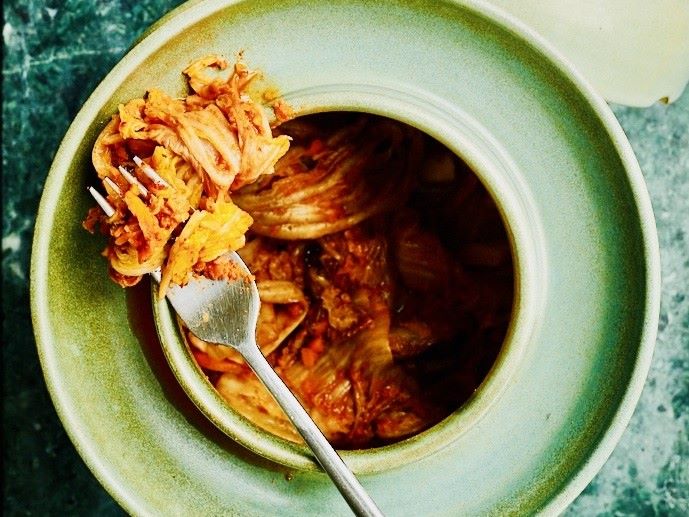
The traditional Korean method differs in a few places. Korean cooks halve the Chinese cabbage lengthways and pack coarse sea salt in between the leaves, or steep it in salted water. After a night, the cabbage has gone limp and lost a lot of its moisture. They rinse it, squeeze out what is left, then work a paste of the seasonings (garlic, ginger, gochugaru, fish sauce) in between the leaves. The whole cabbage goes into the jar as a parcel to ferment.
It looks glorious: whole folded leaves coated in red paste. There is a catch, though. The final salt level is hard to judge if the proportions were never handed down to you. Too much salt and the kimchi is inedible. Too little and you risk unwanted, potentially dangerous bacteria. Weighing your salt removes that uncertainty.
Both methods make excellent kimchi. The traditional one asks for experience and feel, the modern one gives you certainty. Start with the modern method and try the traditional one once you have some experience behind you.
Kimchi without fish sauce
For a vegetarian or vegan kimchi, simply leave out the fish sauce. That is the whole trick. The result has a little less umami depth, but it is still very good. If you want that depth back, snip up a sheet of nori or kombu and let it ferment along, or add a splash of soy sauce.
What types of kimchi are there?
Kimchi does not have to be made with Chinese cabbage at all. White cabbage, pointed cabbage and red cabbage all work just as well. Red cabbage gives a spectacular colour (everything turns deep purple), while white cabbage behaves much like Chinese cabbage but stays firmer. The principle stays the same: cut, weigh, 2% salt, knead, ferment.
The variation runs far deeper than cabbage, though. There are more than a hundred types of kimchi. The best known is baechu kimchi (the recipe above), but here are a few more:
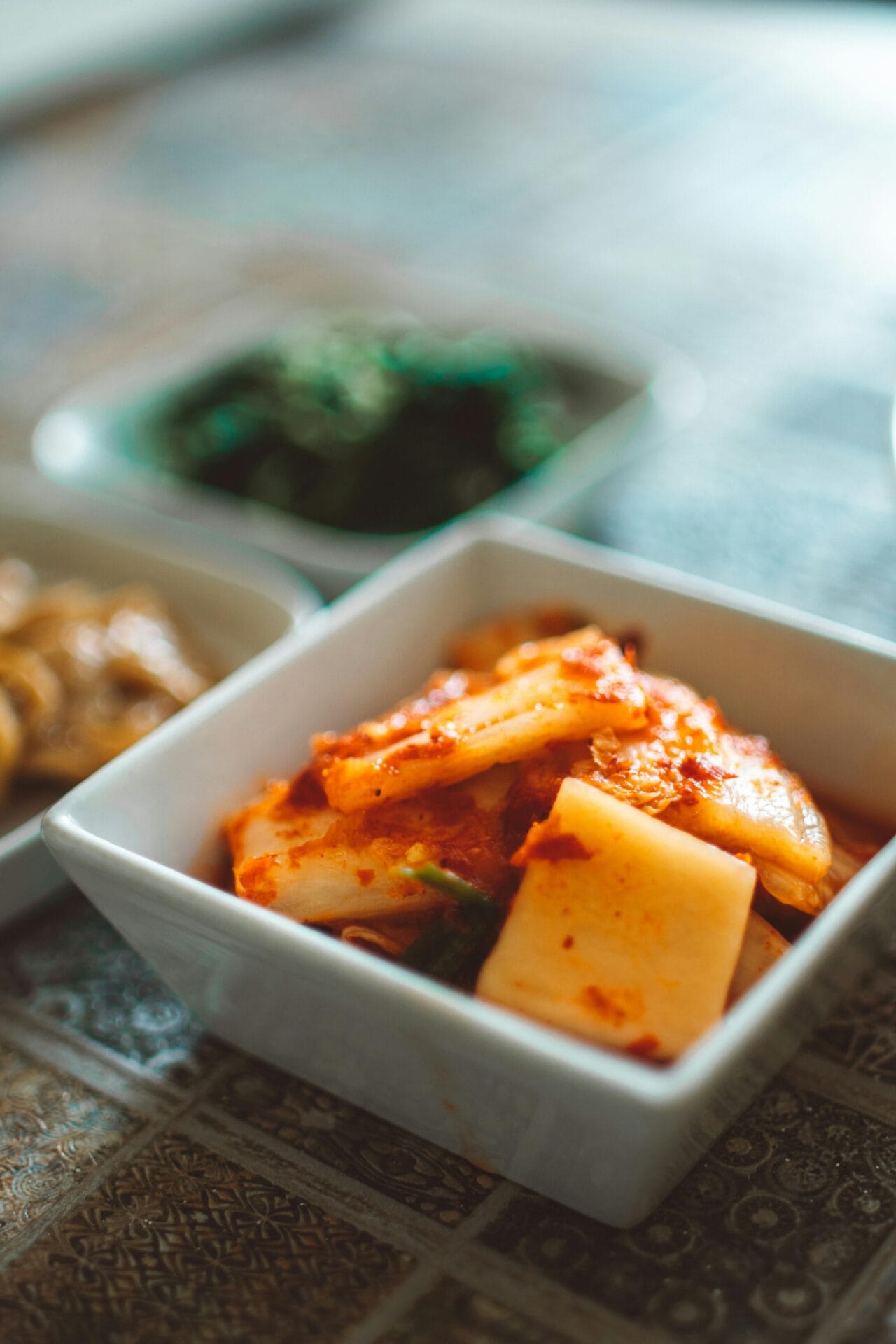
- Kkakdugi: kimchi made from daikon, cut into cubes. Crunchy and fresh.
- White kimchi (baek kimchi): the same vegetables, without the red pepper powder. Often with a piece of apple or pear added, which works surprisingly well.
- Paa kimchi: spring onion kimchi. Long stalks fermented in the kimchi paste.
- Oi sobagi: cucumber kimchi. The cucumbers are split open, salted briefly and stuffed with the seasoning paste.
- Carrot kimchi (tanggun kimchi): the same idea as daikon kimchi, but with carrot.
And then there are versions with oyster, squid, pine nuts, mushrooms and even 7-Up. Yes, really.
And kimchi made from sauerkraut? You can stir gochugaru and the other seasonings through ready-made sauerkraut. It works, and it tastes reasonable. But it is a bit of a cheat, and a fairly crude one. The fermentation has already happened, and the flavour is nowhere near freshly made kimchi.
The three dangers (and how to avoid them)
Fermenting is very safe, as long as you follow a few ground rules. With kimchi there are three things to watch.
1. The wrong bacteria
The fix is simple: use 2% salt. That level creates conditions where lactic acid bacteria thrive and pathogens cannot survive. Once the lactic acid bacteria get going, they produce lactic acid. The pH drops and the product becomes safer by the day.
2. Explosions
Fermentation releases CO₂. If your kimchi sits in a hermetically sealed jar, pressure builds up. Use a jar with an airlock, a Weck jar (the rubber ring lets the gas escape by itself), or ferment in a vacuum bag. A jar with a loose lid works too. Stand it on a plate, because liquid tends to overflow.
3. Mould
Mould grows where there is oxygen. As long as your vegetables sit under the liquid, mould has nowhere to go. Use fermentation weights (available in glass and plastic) to hold everything under the brine, or pick a jar with an airlock. A vacuum bag is the most mould-proof option of all: no oxygen, no mould.
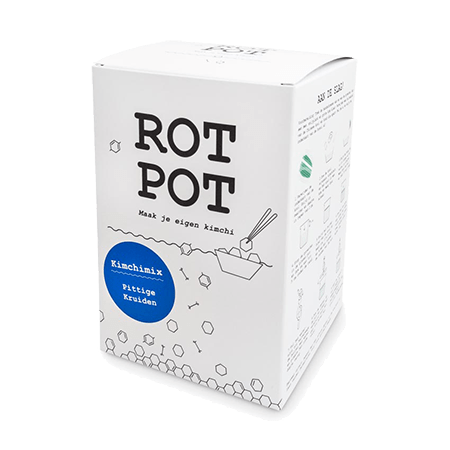
At startercultures.eu you will find all the tools for vegetable fermentation, including jars with airlocks, the RotPot starter kit (kimchi seasonings included) and pH strips to follow your ferment.
Kimchi workshop
Would you rather learn this with someone guiding you? In the online kimchi workshop, Meneer Wateetons walks you through the whole process step by step: buying the ingredients, fermenting and storing. You learn to make kimchi, and you learn the principles behind fermentation as well, so afterwards you can ferment whatever vegetable you like. The workshop is in English and you watch it whenever suits you.
Want to go further? Have a look at the other online fermentation workshops too, covering everything from vegetables to dairy, beans and grains.


Frequently asked questions

About the author (Meneer Wateetons)
Meneer Wateetons is a renowned Dutch foodwriter, teacher, fermentation specialist, sausage maker and the owner of startercultures.eu. He has written 9 books on culinary topics such as fermentation, alcohol making, sausages and charcuterie making and deep frying. He has taught many hobbyists, chefs and food professionals about these topics.
Related Posts

Preserved lemons: how to salt-cure and ferment your own
Preserved lemons are a Moroccan staple. We cover two routes: the classic salt-cured method, and a low-salt version that genuinely ferments. Plus variations, peel advice and common mistakes.

How to make yogurt at home – and answer to all your questions
Learn how to make yogurt at home: from Greek yogurt to Bulgarian yogurt and skyr. With an extensive FAQ covering the most common questions and problems.

What is kombucha?
What is kombucha? Discover what this tangy fermented tea drink is: the SCOBY, the flavour, where it comes from, and how to brew and drink it yourself.